Case Study Analysis
Nội dung bài viết
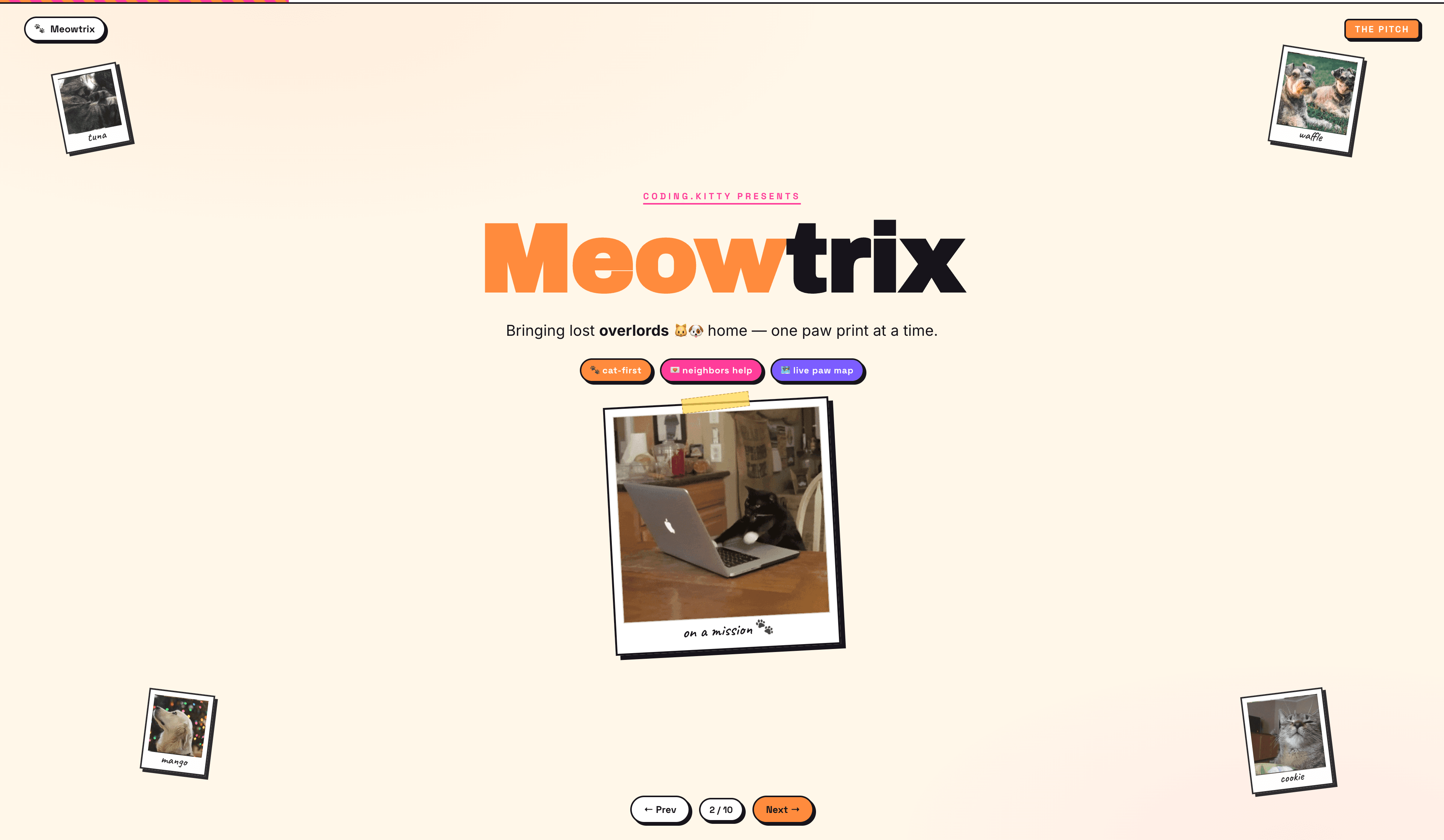
🐾 MEOWTRIX — Case Study
A real-time intelligence platform for tracking and recovering lost pets,
powered by AI vision and durable workflow orchestration.

📌 Project Overview#
| Project | MEOWTRIX — Pet Overlord Tracker |
| Role | Full-Stack Developer |
| Timeline | 2025 |
| Stack | Next.js 15 · TypeScript · Supabase · Tailwind CSS · Google Gemini AI · Temporal · Vercel |
| Category | AI-Powered SaaS · Real-Time Platform · Community Tool |
🎯 The Problem#
Every year, millions of pets go missing worldwide. Pet owners face an agonizing ordeal — sharing blurry photos across social media groups, printing flyers, and manually scanning "found pet" posts hoping for a visual match.
The existing solutions suffer from critical gaps:
- No intelligent matching — owners manually compare photos across dozens of groups
- No automated escalation — search efforts stall after the first few hours
- No structured verification — reunions rely on trust alone, with no identity challenge
- Fragmented communication — sightings are scattered across platforms with no correlation
What if we could build an intelligence platform that treats every missing pet like a spy operation — with AI-powered identification, automated escalation protocols, and a community of field agents?
💡 The Solution#
MEOWTRIX reimagines pet recovery as a command-center operation, wrapped in a playful spy-agency aesthetic:
Core Capabilities#
| Operation | Codename | What it does |
|---|---|---|
| 🔴 | OVERLORD_DOWN | File a missing pet report with photos, GPS location, and traits |
| 🟢 | AGENT_SPOTTED | Log a found-pet sighting — AI extracts traits from photos instantly |
| 🧠 | PATTERN_LOCK | Gemini AI compares visual traits and scores potential matches |
| 🗺️ | ZONE_PREDICT | Probability heatmaps expand over time on an interactive map |
| ⏰ | SEARCH_PROTOCOL | Automated 6h → 24h → 48h → 14d escalation workflow |
| ✅ | CLAIM_VERIFY | 3-question identity challenge to confirm ownership before reunion |
🏗️ Architecture Deep Dive#
The system is designed as a serverless-first, event-driven platform that separates concerns across multiple runtime layers.

Key Architectural Decisions#
1. Next.js 15 App Router as the API gateway
All data mutations flow through API routes — the client never touches Supabase directly. This enforces server-side validation (Zod schemas), keeps secrets out of the browser bundle, and centralises the match-trigger logic.
2. Supabase as the unified backend
PostgreSQL with Row-Level Security on every table handles auth, data, file storage, and real-time subscriptions through a single managed service. A custom overlords_public view masks sensitive verification fields (secret name, marking, trait) so they're only returned to the pet's owner.
3. Temporal for durable workflows
The escalating search protocol (6h → 24h → 48h → 14d) needs timers that survive server restarts, Vercel cold starts, and deployment cycles. Temporal workflows run as a separate Node.js process and are inherently idempotent — every stage checks isOverlordResolved() before executing, so early cancellation is safe.
4. Dual Supabase clients
The server maintains two clients: an anon client for user-scoped reads (respecting RLS) and a service-role client for privileged writes (cross-user notifications, workflow callbacks). This separation prevents accidental privilege escalation.
Runtime Processes#
| Process | Where it runs | Responsibilities |
|---|---|---|
| Web App + API | Vercel (Node runtime) | UI rendering, API routes, Gemini calls, Temporal workflow starts |
| Middleware | Vercel Edge | Session refresh, protected route guards |
| Temporal Worker | Long-lived Node process | Executes timed workflows, generates posters, sends emails |
| Browser Client | User's browser | React UI, Leaflet maps, real-time WebSocket subscriptions |
🧠 The AI Match Engine#
The heart of MEOWTRIX is a multi-signal scoring algorithm that compares lost pet reports against found-pet sightings to surface the most likely matches.

How It Works#
Step 1 — Trait Extraction (Google Gemini Vision)
When a user uploads a pet photo, the image is sent to Google Gemini's multimodal API. The AI extracts structured trait tags:
json{ "primary_color": "orange", "secondary_color": "white", "pattern_type": "tabby", "breed_estimate": "domestic shorthair", "fur_length": "short" }
Step 2 — Multi-Signal Scoring
Each lost-found pair is scored across four weighted dimensions:
| Signal | Weight | Method |
|---|---|---|
| 🎨 Visual Similarity | 40% | Color similarity with fuzzy grouping (e.g. "ginger" ≈ "orange" = 60%) + pattern match |
| 📝 Text Description | 25% | Jaccard token overlap between free-text descriptions |
| 📍 Proximity | 25% | Haversine distance — inverse scoring (≤500m = 100%, decaying outward) |
| 🧬 Other Traits | 10% | Breed estimate (exact = 100, substring = 50) + fur length match |
Step 3 — Threshold + Alert
Any pair scoring ≥ 60/100 triggers a real-time notification to the pet owner. A maximum of 10 suggestions are generated per lost pet to prevent alert fatigue.
Color Similarity — A Design Decision#
Rather than requiring exact color matches (which would miss "ginger" vs "orange"), the engine uses fuzzy color grouping:
light:  white, cream, ivory, beige, silver, fawn
grey:   grey, gray, charcoal, slate
brown:  brown, chocolate, tan, liver, chestnut
orange: orange, ginger, red, rust, cinnamon, apricot
black:  black, ebony
golden: golden, yellow, buff
Colors within the same group score 60 (instead of 0), dramatically reducing false negatives from synonym mismatches.
⏱️ Escalating Search Protocol#
One of the most innovative features is the time-based search escalation — a durable workflow that progressively intensifies the search effort if the pet hasn't been found:
┌──────────────────────────────────────────────────────────────────────┐
│                    SEARCH PROTOCOL TIMELINE                         │
│                                                                      │
│  ⏱ 0h ──── 📋 Report filed                                         │
│             └─ Immediate "lost_nearby" blast (~5km bounding box)    │
│                                                                      │
│  ⏱ 6h ──── 🔔 Notify nearby helpers                                │
│             └─ Consent-based alert within 1km radius                │
│                                                                      │
│  ⏱ 24h ─── 📄 Auto-generate missing poster                         │
│             └─ PDFKit renders a printable flyer with photo + traits  │
│                                                                      │
│  ⏱ 48h ─── 📡 Expand search radius                                 │
│             └─ Radius grows to 5km, excludes already-notified users │
│                                                                      │
│  ⏱ 14d ─── 🏁 Search concluded                                     │
│             └─ Final status update to owner                          │
│                                                                      │
│  ✅ Pet found at any stage? Workflow auto-cancels immediately.       │
└──────────────────────────────────────────────────────────────────────┘
Why Temporal?#
Standard setTimeout or cron jobs can't survive:
- Vercel function cold starts and timeouts (max 60s on Hobby)
- Server redeployments during a 14-day window
- Duplicate execution on retry
Temporal provides durable execution — workflows persist their state across restarts, retries are automatic, and the timer logic is expressed as plain TypeScript with await sleep() semantics.
🛡️ Security & Trust#
| Layer | Implementation |
|---|---|
| Database | Row-Level Security on every table — users only see their own data |
| Verification | 3-step claim challenge with lockout after 3 failures |
| Uploads | Format + size validation (JPEG/PNG/WebP, ≤5MB) via Sharp |
| Secrets | Server-side only — GEMINI_API_KEY, SERVICE_ROLE_KEY never in bundles |
| CI/CD | Aikido SAST + dependency audit on every PR + npm audit in pipeline |
The Claim Verification Flow#
To prevent false reunions, MEOWTRIX implements a 3-question identity challenge:
- Owner sets three secret verification facts when filing the report (pet's real name, a distinctive marking, a behavioral trait)
- When someone claims a match, they must answer all three correctly
- Three failures = permanent lockout on that claim — preventing brute-force guessing
🗺️ Interactive Mapping#
The platform uses Leaflet.js with heatmap overlays to visualize:
- 📍 Last known locations of lost pets
- 👁️ Sighting reports from community agents
- 🔥 Predictive probability zones that expand over time
- 📏 Search radius rings (1km → 5km progression)
Maps are dynamically imported with ssr: false to avoid server-side rendering issues with Leaflet's DOM dependency.
🏆 Community Gamification#
To incentivize community participation, MEOWTRIX includes an Informant Leaderboard:
- +10 points per verified pet recovery
- Ties broken by earliest match timestamp
- Real-time updates via Supabase Realtime subscriptions
- Social sharing with Open Graph meta tags for bragging rights
📈 Technical Challenges & Lessons Learned#
Challenge 1: Gemini Trait Extraction Reliability#
Problem: AI vision models occasionally return inconsistent trait tags for the same animal under different lighting.
Solution: Implemented a retryable /api/vision/process endpoint that re-processes photos on failure, and designed the match engine to use fuzzy color grouping to absorb minor discrepancies.
Challenge 2: Real-Time Notifications at Scale#
Problem: Supabase Realtime subscriptions needed to push match alerts to specific users without broadcasting to everyone.
Solution: Used row-level filtering on the notifications table — each client subscribes only to rows matching their user_id, leveraging Supabase's built-in RLS for the real-time channel.
Challenge 3: Balancing Precision vs. Recall in Matching#
Problem: Too strict → missed matches. Too loose → alert fatigue.
Solution: The 60/100 threshold with a cap of 10 suggestions per pet was tuned through iteration. The weighted formula (40% visual, 25% text, 25% proximity, 10% other) reflects that visual similarity is most decisive, while proximity prevents cross-city false positives.
Challenge 4: Durable Timers Across Serverless Boundaries#
Problem: Vercel functions have a 60-second timeout — you can't sleep(6 hours) in a serverless function.
Solution: Temporal's durable execution model separates timer logic into a dedicated worker process. The Next.js API route only starts the workflow (instant RPC call) — the worker runs independently for up to 14 days.
🔧 Tech Stack Summary#
| Layer | Technology | Why |
|---|---|---|
| Framework | Next.js 15 (App Router) | Server Components, API routes, edge middleware |
| Language | TypeScript (strict mode) | Type safety across full stack |
| Styling | Tailwind CSS + shadcn/ui | Rapid iteration with consistent design tokens |
| Database | Supabase (PostgreSQL + RLS) | Unified auth, data, storage, and real-time |
| AI Vision | Google Gemini API | Multimodal trait extraction from pet photos |
| Maps | Leaflet.js + OpenStreetMap | Open-source, customizable, heatmap support |
| Workflows | Temporal | Durable execution for multi-day escalation timelines |
| Resend | Transactional email for claims and escalations | |
| Hosting | Vercel | Zero-config deploys, edge network, preview deploys |
| Security | Aikido | Continuous SAST + dependency scanning |
🚀 Results & Impact#
- ⚡ Sub-second match scoring — AI trait extraction + multi-signal scoring in a single API round-trip
- 🔔 Real-time alerts — owners notified within milliseconds of a match via Supabase Realtime
- 🤖 Zero manual matching — the AI engine eliminates the need to manually compare photos
- 📄 Automated poster generation — printable missing-pet flyers generated without owner effort
- 🛡️ Secure reunions — 3-step verification prevents false claims
- 📈 Progressive escalation — search intensity automatically increases over 14 days
🐾 MEOWTRIX — TRUST NO ONE. FIND THEM. 🐾
Built with Next.js, Supabase, Google Gemini AI, and Temporal.